
Bobby stayed at home from school today but is planning on going to school tomorrow. Katie had no energy to go to the viola/violin group class with Daisy this evening.
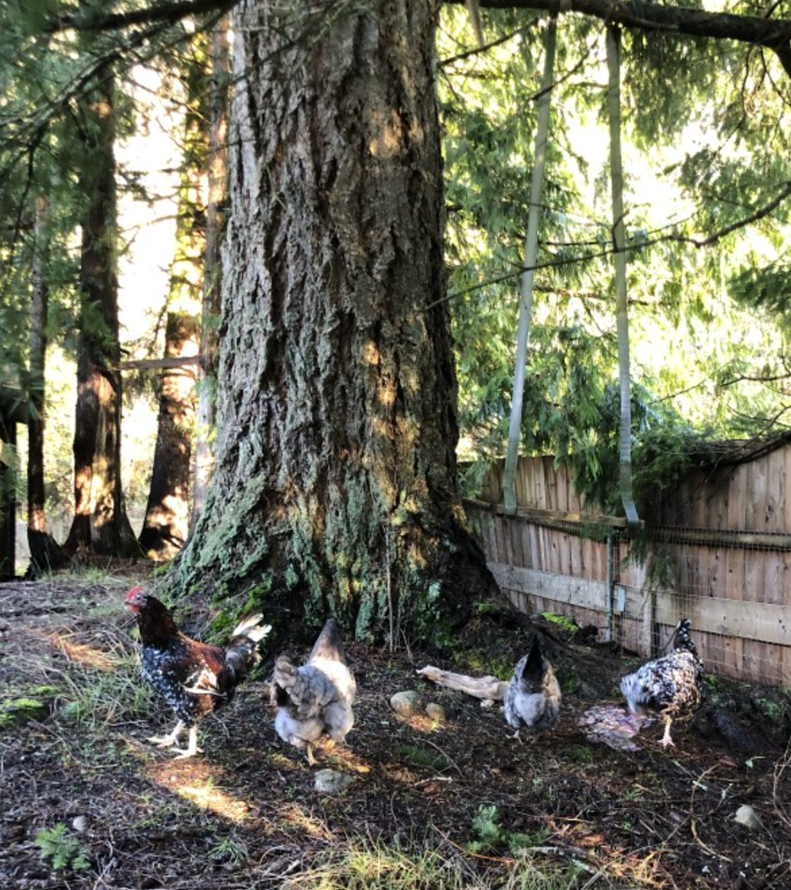
The chickens are getting more and more adventuresome. They worked there way to the swing on the other side of barn from their coop today (see photo to the right).
My leg/knee is acting up again. This reminds me of my friend in Australia who got me into marathon running all those years ago. He would be training and every so often he would pull a muscle (perhaps Achilles heel), and would have to withdraw from the race he was training for. Maybe this is what’s happening to me in that there is one muscle or tendon near my knee that is straining out from time to time.
My wife and Katie are always looking for something to watch on television. The other day I was telling Katie about the old 1950’s B&W series the Twilight Zone and more specifically the episode where the guy breaks his glasses. I think they are on Netflix now. In a nutshell:
The original The Twilight Zone, created by Rod Serling, was a landmark 1950s science-fiction anthology that used speculative stories to explore human frailty, irony, and moral consequence rather than relying on special effects. One of its most famous episodes, Time Enough at Last, centers on Henry Bemis, a quiet, book-loving man who is constantly mocked for his devotion to reading and denied time to enjoy it. After a nuclear explosion wipes out civilization, Bemis finally finds himself alone in a ruined world with all the time he could ever want to read. In a devastating twist that defines the series’ reputation for cruel irony, his eyeglasses fall and shatter just as his long-awaited freedom arrives, leaving him effectively blind and unable to enjoy the books that survived humanity. The episode endures because it captures a core Twilight Zone theme: the universe doesn’t punish cruelty—it punishes misplaced hope, revealing how fragile our dreams can be when they depend on a single, breakable condition.
I watched watched a video about the tamarillo plant today. As the description says, most gardeners faithfully replant tomatoes every year without realizing there’s a far better alternative. While a standard tomato plant produces for just a few months before dying, the tamarillo—also known as the Andean “tree tomato”—can produce fruit for up to 20 years, yielding as much as 3,000 pounds over its lifetime. It fruits in winter, stores for up to six months without refrigeration, and requires no annual replanting. It was once a staple of 1940s Victory Gardens before quietly disappearing when industrial agriculture shifted toward profitable annual seed cycles. This video breaks down the economics of renting your garden versus owning it, explains the science behind the tamarillo’s thick, bitter skin that acts like a natural vacuum seal, and reveal a simple three-second blanching technique that removes the bitterness instantly—unlocking a savory, tangy “survival sauce” hidden inside this forgotten red gold.
My wife was so fascinated with the tamarillo that she ordered seeds to grow them. One for the “Barn Suite” as well.
This reminded me of when my wife got some catnip plants a while ago. He liked them!